



Contents
Scroll to:
https://doi.org/10.21886/2308-6424-2026-14-4-68-77
Scroll to:
Introduction. Bladder exstrophy-epispadias complex requires complex surgical repair. Complete primary repair of exstrophy and modern staged repair of exstrophy are the two principal approaches, but their comparative outcomes have not been quantitatively pooled.
This review assessed whether complete primary repair differs from staged repair in continence, surgical morbidity, reoperation, and upper urinary tract outcomes.
Materials & methods. PubMed / MEDLINE, Scopus, Europe PMC, and Epistemonikos were searched from inception to April 1, 2026. Comparative studies of patients with classic bladder exstrophy or bladder exstrophy-epispadias complex were included. Two authors independently selected studies, extracted data, and assessed risk of bias with the Newcastle-Ottawa Scale. Random-effects meta-analysis generated risk ratios with 95% confidence intervals.
Results. Eight studies including 878 patients were analyzed. No significant difference was detected for overall continence, spontaneous voiding, dry interval, or subsequent bladder neck reconstruction. Complete primary repair was associated with higher redo bladder closure, overall reoperation, and febrile urinary tract infection. The redoclosure finding depended on one referral-center study and became non-significant after its exclusion. Upper urinary tract outcomes were comparable.
Conclusion. No significant continence difference was detected, but equivalence cannot be inferred because several analyses were underpowered. Complete primary repair carried higher closure-related and infectious morbidity in the available observational evidence. Surgical choice should be individualized according to patient factors and institutional expertise.
Alhanifa A., Abhikrama I., Tirtayasa P., Duarsa G. Complete primary repair versus modern staged repair for bladder exstrophy-epispadias complex: a systematic review and meta-analysis. Urology Herald. 2026;14(4):68-77. https://doi.org/10.21886/2308-6424-2026-14-4-68-77
Bladder exstrophy-epispadias complex (BEEC) is a rare congenital malformation of the genitourinary system, occurring in approximately 1 in 30,000 to 50,000 live births, with a male-to-female ratio of about 2.3:1 [1][2]. Classic bladder exstrophy is the most common and clinically relevant form and is characterized by an exposed bladder plate, pubic diastasis, and epispadias. Without surgical reconstruction, patients may develop continuous urinary incontinence, recurrent infection, progressive renal injury, and psychosocial impairment [3].
Two reconstructive strategies dominate contemporary management. Modern staged repair of exstrophy (MSRE), as developed from the Jeffs approach, begins with neonatal bladder and abdominal wall closure, followed by epispadias repair at approximately 6 to 12 months and bladder neck reconstruction at about 4 to 6 years when bladder capacity is adequate [4]. Complete primary repair of exstrophy (CPRE), introduced by Mitchell and Bagli, combines bladder closure, epispadias repair, and partial bladder-neck reconstruction during one neonatal operation [5][6].
The optimal approach remains uncertain. Comparative studies are mostly retrospective, single-center, and limited by small samples, heterogeneous continence definitions, and variable follow-up. Reported continence after CPRE ranges from 23% to 80%, while multi-institutional data suggest that few patients achieve continence with spontaneous voiding after one CPRE procedure [7]. MSRE outcomes also vary by institutional experience [8]. Whether the potential reduction in planned operations with CPRE offsets greater risks of closure failure, urinary tract infection, and reoperation remains unclear [9].
Objective. This systematic review and meta-analysis evaluated whether CPRE, compared with MSRE, is associated with differences in continence and functional outcomes, surgical complications and reoperations, and renal or urologic outcomes in patients with classic bladder exstrophy or BEEC [10].
Protocol and registration. This systematic review and meta-analysis was conducted according to PRISMA 2020 guidance [11][12]. The protocol was registered prospectively in PROSPERO (registration number: CRD420261292831).
Eligibility criteria. Eligible studies compared CPRE, including technical variants, with MSRE in patients with classic bladder exstrophy or BEEC. Outcomes of interest included continence and functional endpoints, surgical complications and reoperations, and renal or urologic complications. Randomized and nonrandomized comparative cohort studies were eligible regardless of date, language, or sample size. Non-comparative studies, isolated epispadias, cloacal exstrophy, case reports, editorials, narrative reviews, expert opinion, and non-human or cadaveric studies were excluded.
Search strategy and selection of studies. PubMed/MEDLINE, Scopus, Europe PMC, and Epistemonikos were searched from inception to April 1, 2026. MeSH terms and keywords for BEEC were combined with terms for complete primary repair and staged reconstruction; equivalent strategies were adapted for each database. Reference lists of included studies and relevant reviews were hand-searched, and trial registries were screened for completed unpublished comparative studies. The full search strategy is provided in Additional file 1.
Data extraction. Two investigators independently extracted study characteristics, patient demographics, surgical techniques, use of osteotomy, follow-up duration, and functional, surgical, and renal outcomes using a standardized form. Extracted data were checked by another independent investigator.
Risk of bias assessment. Risk of bias was assessed with the Newcastle-Ottawa Scale (NOS) for nonrandomized studies [13]. The scale evaluates selection, comparability, and outcome ascertainment. Studies were classified according to Agency for Healthcare Research and Quality standards as good, fair, or poor quality.
Outcome measures. Functional outcomes included overall continence, spontaneous voiding without clean intermittent catheterization (CIC), dry interval greater than 2 to 3 hours, and subsequent bladder neck reconstruction. Surgical outcomes included bladder dehiscence, urethrocutaneous fistula, urethral stricture, redo bladder closure, and overall reoperation. Renal and urologic outcomes included febrile urinary tract infection (UTI), vesicoureteral reflux (VUR), new or worsening hydronephrosis, and renal impairment or scarring.
Data synthesis and statistical analysis. Analyses were conducted in R software v3.13 (The R Foundation for Statistical Computing, Vienna, Austria). Pooled risk ratios (RRs) and 95% confidence intervals (CIs) were calculated using random-effects meta-analysis with restricted maximum likelihood estimation. Heterogeneity was assessed with the I² statistic, interpreted as 0 – 25% low, 26 – 50% moderate, 51 – 75% substantial, and > 75% considerable. Leave-one-out sensitivity analyses were performed for outcomes with substantial heterogeneity or disproportionate study weighting. Funnel plots and Egger's regression were exploratory [14]. Statistical significance was set at p < 0.05.
Study selection. The search identified 1,113 records. After 487 duplicates were removed, 626 records were screened and 616 were excluded. Nine reports were sought for full text, 1 could not be retrieved, and 8 studies were assessed for eligibility and included in the final meta-analysis (Fig. 1) [4][9][15 – 20].

Figure 1. Preferred Reporting Items for Systematic Reviews and Meta-Analyses 2020 flow diagram of study selection
Study characteristics. The 8 included studies were published from 2005 to 2026 and comprised 878 patients with BEEC (315 CPRE, 563 MSRE) (Table 1). Seven studies were retrospective and 1 was prospective. Studies were conducted in North America, Europe, and Asia. Age at initial surgery ranged from neonatal repair to a median of 17 months, and follow-up ranged from about 1 year to 18 years where reported. Techniques included Mitchell, Mitchell-Bagli, delayed primary, and single-stage Erlangen CPRE variants compared with staged closure, epispadias repair, and later bladder neck reconstruction. Osteotomy use varied widely across centers.
Table 1. Characteristics of included studies
|
Study |
Country |
Design |
N (CPRE / |
Male % |
Age at Initial Surgery |
Follow-up Duration (CPRE / MSRE) |
Core Surgical Strategy (CPRE vs. MSRE) |
Osteotomy % |
|
O. Alsowayan et al., 2016 [15] |
Canada |
Retro Cohort |
10 / 6 |
40% / 50% |
≤ 2 days / ≤ 2 days |
Mn 18 yrs (Combined) |
CPRE: NR MSRE: Closure (neonatal) → Epispadias (1.5–2y) → BNR (by 5y) |
30% / 67% |
|
J.G. Borer et al., 2005 [5] |
USA |
Retro Cohort |
23 / 14 |
70% / 57% |
≤ 3 days / NR |
Mn 2.2 yrs / Mn 4.1 yrs |
CPRE: Mitchell technique MSRE: BNR via modified Young-Dees-Leadbetter |
NR |
|
A. Bueno-Jiménez et al., 2020 [20] |
Spain |
Retro Cohort |
6 / 13 |
100% / 100% |
Med 56 days / 1 day |
Mn 1 yr / |
CPRE: Delayed primary closure w/ epispadias repair MSRE: 3-stage (Neonatal closure → Epispadias → BNR) |
0% / 15% |
|
M.E. Chua et al., 2018 [17] |
Canada |
Retro Cohort |
10 / 11 |
100% / 100% |
Med 4.5 days / 2 days |
Med 9.7 yrs / Med 4.0 yrs |
CPRE: Mitchell-Bagli w/ complete disassembly & reimplant MSRE: Closure w/ BNR tailoring → Deferred epispadias |
100% / 100% |
|
A.K. Ebert et al., 2020 [18] |
Germany |
Prosp Cohort |
64 / 83 |
67% (Overall) |
Mn 0.5 yrs / 0.7 yrs |
Med 8 yrs / Med 10 yrsa |
CPRE: Single-stage (Erlangen) MSRE: Postnatal closure → Delayed BNR (Med age 6) |
6% / 7% |
|
B.M. Inouye et al., 2018 [9] |
USA |
Retro Cohort |
159 / 406 |
70% (Overall) |
Early (≤ 30d) |
NR |
CPRE: NR MSRE: NR |
39% (Overall) |
|
A.A. Khawaja et al., 2012 [19] |
Pakistan |
Retro Cohort |
8 / 10 |
38% / 100% |
Mn 4 mos / |
Up to 2 yrs |
CPRE: 1-stage w / penile disassembly & urethroplasty MSRE: Closure & early BNR → Deferred penile disassembly |
100% / 100% |
|
K.J. Rathod et al., 2026 [20] |
India |
Retro Cohort |
35 / 20 |
66% / 60% |
Mn 17 mos / |
NR |
CPRE: Bladder/epispadias closure + early BNR MSRE: Closure → Delayed BNR (often requiring diversions) |
29% / 5% |
|
Note. CPRE — Complete Primary Repair of Exstrophy; MSRE — Modern Staged Repair of Exstrophy; Retro — retrospective; Prosp — prospective; Mn — mean; Med — median; NR — not reported; BNR — bladder neck reconstruction. Follow-up durations for Ebert 2020 represent the specific continence subgroup evaluated |
||||||||
Risk of bias in included studies. Seven studies were classified as good quality and 1 as poor quality (Table 2). Selection and outcome domains were generally strong, with mean scores of 3.75 / 4 and 2.88 / 3, respectively. Comparability was the most frequent limitation: 3 studies used multivariable adjustment for key confounders [4][9][20], whereas others lacked formal adjustment. The study by A.A. Khawaja et al. (2012) was rated poor because of a comparability score of 0, reflecting gender imbalance without adjustment [19].
Table 2. Newcastle-Ottawa Scale risk of bias assessment of included studies
|
Study |
Selection |
Comparability |
Outcome |
Quality |
AHRQ Classification |
|
O. Alsowayan et al., 2016 [15] |
4 |
1 |
3 |
8 |
Good quality |
|
J.G. Borer et al., 2005 [5] |
4 |
2 |
3 |
9 |
Good quality |
|
A. Bueno-Jiménez et al., 2020 [20] |
4 |
1 |
3 |
8 |
Good quality |
|
M.E. Chua et al., 2018 [17] |
4 |
1 |
3 |
8 |
Good quality |
|
A.K. Ebert et al., 2020 [18] |
4 |
1 |
2 |
7 |
Good quality |
|
B.M. Inouye et al., 2018 [9] |
3 |
2 |
3 |
8 |
Good quality |
|
A.A. Khawaja et al., 2012 [19] |
3 |
0 |
3 |
6 |
Poor quality |
|
K.J. Rathod et al., 2026 [20] |
4 |
2 |
3 |
9 |
Good quality |
|
Note. AHRQ — Agency for Healthcare Research and Quality |
|||||
Meta-analysis results. Functional and continence outcomes. Overall continence did not differ significantly between CPRE and MSRE (RR 0.98, 95% CI 0.52 to 1.84, p = 0.95) (Fig. 2), with moderate heterogeneity (I² = 51.4%). Spontaneous voiding without CIC (RR 0.94, 95% CI 0.55 to 1.62, p = 0.82), dry interval > 2 to 3 hours (RR 0.91, 95% CI 0.76 to 1.10, p = 0.35), and subsequent bladder neck reconstruction (RR 0.77, 95% CI 0.53 to 1.10, p = 0.15) were also comparable.

Figure 2. Forest plot of pooled risk ratios for overall continence (CPRE — Complete Primary Repair of Exstrophy; MSRE — Modern Staged Repair of Exstrophy; RR — risk ratio; CI — confidence interval)
Surgical complications and reoperations. Bladder dehiscence did not differ significantly between approaches (RR 0.50, 95% CI 0.14 to 1.76, p = 0.28). No significant differences were found for urethrocutaneous fistula (RR 1.22, 95% CI 0.65 to 2.30, p = 0.54) or urethral stricture (RR 2.40, 95% CI 0.34 to 16.89, p = 0.38). CPRE was associated with higher redo bladder closure (RR 1.99, 95% CI 1.54 to 2.58, p < 0.0001) (Fig. 3) and overall reoperation (RR 1.64, 95% CI 1.15 to 2.34, p = 0.006; Fig. 4).

Figure 3. Forest plot of pooled risk ratios for redo bladder closure (CPRE — Complete Primary Repair of Exstrophy; MSRE — Modern Staged Repair of Exstrophy; RR — risk ratio; CI — confidence interval)
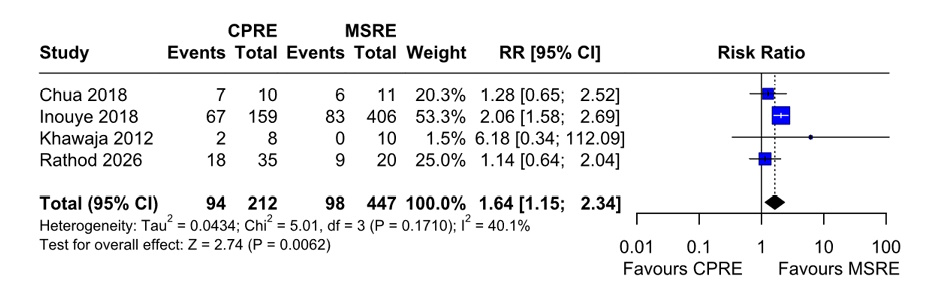
Figure 4. Forest plot of pooled risk ratios for overall reoperation (CPRE — Complete Primary Repair of Exstrophy; MSRE — Modern Staged Repair of Exstrophy; RR — risk ratio; CI — confidence interval)
Renal and urologic complications. CPRE was associated with a higher incidence of febrile UTI (RR 1.61, 95% CI 1.21 to 2.14, p = 0.001; Fig. 5). VUR (RR 0.99, 95% CI 0.80 to 1.22, p = 0.90), new or worsening hydronephrosis (RR 1.22, 95% CI 0.36 to 4.16, p = 0.75), and renal function or scarring outcomes (RR 1.25, 95% CI 0.30 to 5.26, p = 0.76) were not significantly different between groups.

Figure 5. Forest plot of pooled risk ratios for febrile urinary tract infection (CPRE — Complete Primary Repair of Exstrophy; MSRE — Modern Staged Repair of Exstrophy; RR — risk ratio; CI — confidence interval)
Table 3. Pooled meta-analysis results comparing complete primary repair of exstrophy versus modern staged repair of exstrophy
|
Outcome Domain |
Outcome |
Studies (n) |
Patients (Total) |
RR (95% CI) |
p-value |
I² (%) |
Significance |
|
Functional and Continence |
Overall continence |
4 |
116 (75 / 41) |
0.98 (0.52 – 1.84) |
0.95 |
51.4% |
Non-significant |
|
Functional and Continence |
Spontaneous voiding w/o CIC |
3 |
58 (38 / 20) |
0.94 (0.55 – 1.62) |
0.82 |
0.0% |
Non-significant |
|
Functional and Continence |
Dry interval > 2 – 3 hours |
2 |
34 (18 / 16) |
0.91 (0.76 – 1.10) |
0.35 |
0.0% |
Non-significant |
|
Functional and Continence |
Need for bladder neck reconstruction |
3 |
184 (98 / 86) |
0.77 (0.53 – 1.10) |
0.15 |
0.0% |
Non-significant |
|
Surgical Complications & Reoperations |
Bladder dehiscence |
4 |
108 (59 / 49) |
0.50 (0.14 – 1.76) |
0.28 |
40.8% |
Non-significant |
|
Surgical Complications & Reoperations |
Urethrocutaneous fistula |
4 |
168 (81 / 87) |
1.22 (0.65 – 2.30) |
0.54 |
0.0% |
Non-significant |
|
Surgical Complications & Reoperations |
Urethral stricture |
2 |
39 (18 / 21) |
2.40 (0.34 – 16.89) |
0.38 |
0.0% |
Non-significant |
|
Surgical Complications & Reoperations |
Redo bladder closure |
4 |
618 (183 / 435) |
1.99 (1.54 – 2.58) |
< 0.0001 |
0.0% |
Significant (Higher in CPRE) |
|
Surgical Complications & Reoperations |
Overall reoperation rate |
4 |
659 (212 / 447) |
1.64 (1.15 – 2.34) |
0.006 |
40.1% |
Significant (Higher in CPRE) |
|
Renal and Urologic Complications |
Febrile urinary tract infection |
4 |
221 (98 / 123) |
1.61 (1.21 – 2.14) |
0.001 |
0.0% |
Significant (Higher in CPRE) |
|
Renal and Urologic Complications |
Vesicoureteral reflux (VUR) |
3 |
94 (53 / 41) |
0.99 (0.80 – 1.22) |
0.90 |
0.0% |
Non-significant |
|
Renal and Urologic Complications |
New or worsening hydronephrosis |
5 |
257 (124 / 133) |
1.22 (0.36 – 4.16) |
0.75 |
39.1% |
Non-significant |
|
Renal and Urologic Complications |
Renal function and scarring |
2 |
163 (74 / 89) |
1.25 (0.30 – 5.26) |
0.76 |
32.1% |
Non-significant |
|
Note. Total pooled patients across all studies in the meta-analysis is 878 (315 CPRE, 563 MSRE). Patient numbers for individual outcomes are formatted as total (CPRE / MSRE) |
|||||||
Sensitivity analyses. Leave-one-out analyses showed that overall continence remained non-significant regardless of which study was omitted, although heterogeneity varied. The higher redo-closure risk with CPRE depended on the B.M. Inouye et al. (2018) cohort; after excluding this study, the pooled estimate became non-significant (RR 0.98, 95% CI 0.29 to 3.28, p = 0.97). Hydronephrosis remained non-significant across all iterations, with persistent between-study variability [9].
Publication bias. Egger's regression was exploratory because few studies contributed to most outcomes. No statistically significant funnel-plot asymmetry was detected for outcomes with at least 3 contributing studies, including overall continence, redo bladder closure, overall reoperation, febrile UTI, VUR, and hydronephrosis. Outcomes with only 2 studies could not be assessed; therefore, publication bias cannot be excluded.
This meta-analysis of 8 comparative studies involving 878 children found no significant differences between CPRE and MSRE for continence, spontaneous voiding, dry interval, or subsequent bladder neck reconstruction. CPRE was associated with higher redo bladder closure, overall reoperation, and febrile UTI, whereas upper urinary tract outcomes were not significantly different. These findings reflect the central trade-off between the techniques: CPRE may reduce planned stages but may increase early infectious and closure-related morbidity, while MSRE distributes operative risk across planned stages.
The continence findings are consistent with previous literature. Continence rates after CPRE vary widely, and secondary interventions remain common even after successful initial closure [10]. Multi-Institutional Bladder Exstrophy Consortium data indicate that only 16.7% of patients achieved spontaneous voiding continence after single CPRE, with 40% achieving dry intervals greater than 1 hour at intermediate follow-up [7]. Institutional selection and referral patterns may partly explain differences observed in the cohorts reported by B.M. Inouye et al. (2018), A.K. Ebert et al. (2020), and K.J. Rathod et al. (2026) [9][18][20].
The higher febrile UTI risk with CPRE was the most consistent adverse association. Concomitant bladder neck reconstruction may produce early outlet resistance in a system where VUR is common after exstrophy closure [21][22]. This combination may promote ascending infection. In contrast, MSRE delays bladder neck reconstruction, maintaining a lower-pressure system during early childhood. Recent collaborative data suggest that concomitant bilateral ureteric reimplantation during CPRE may reduce postoperative VUR and pyelonephritis, but this strategy requires further evaluation [22].
Despite the UTI signal, pooled renal outcomes did not show significant differences. This should be interpreted cautiously because renal surveillance differed across studies, including ultrasound, serum creatinine, annual diethylenetriamine pentaacetic acid scanning, and dimercaptosuccinic acid radionuclide imaging. Such heterogeneity may underestimate subtle renal impairment. Longer standardized follow-up is needed before concluding that upper tract risk is equivalent between approaches.
Mechanical closure failure also requires caution. The redo-closure result was strongly influenced by the B.M. Inouye et al. (2018) referral-center cohort; removing that study eliminated statistical significance [9]. Referral centers may receive a disproportionate number of closure failures from outside institutions, inflating risk estimates. Nevertheless, the potential mechanical stress of one-stage reconstruction remains clinically plausible and should be considered alongside center experience and patient anatomy.
Variation in osteotomy use further complicates comparison. Rates ranged from 0% to 100% among included studies, reflecting institutional practice rather than standardized criteria. Osteotomy may facilitate tension-free closure and reduce dehiscence risk, especially when closure is delayed beyond 72 hours [23][24]. However, the model by K.J. Rathod et al. (2026) suggested no significant effect on continence after adjustment [20]. M.E. Chua et al. (2019) also emphasized that aggressive pubic approximation during CPRE can contribute to pelvic compartment syndrome and penile ischemia [17].
Several limitations should be acknowledged. Outcome-specific sample sizes were often small, ranging from 34 to 659 patients, and confidence intervals were wide for rare events. All included studies were observational and vulnerable to selection bias, reporting bias, and confounding by anatomy, surgeon preference, surgical era, center volume, immobilization, and osteotomy use. Definitions of continence also varied, limiting direct comparison. Formal tests did not detect publication bias, but the small number of studies per outcome substantially limits confidence in those tests.
In practice, neither approach can be recommended universally. CPRE may be appropriate in expert centers seeking to reduce scheduled stages and promote early bladder cycling, but the risks of closure failure and febrile UTI must be weighed carefully. MSRE may offer more reliable initial closure at the cost of planned staged operations. Prospective multicenter registries with standardized definitions, long-term follow-up, quality-of-life outcomes, cost-effectiveness data, and reproductive outcomes are needed.
This meta-analysis found no significant differences between CPRE and MSRE in continence, spontaneous voiding, dry interval, or subsequent bladder neck reconstruction. CPRE was associated with higher redo bladder closure, overall reoperation, and febrile UTI, while upper urinary tract outcomes were not significantly different. Because the evidence is observational and several analyses are underpowered, treatment should be individualized according to anatomy, family priorities, institutional expertise, and surgeon experience.
Keypoints
1. Ebert A.K., Zwink N., Reutter H.M., Jenetzky E.A. Prevalence Estimation of Exstrophy and Epispadias in Germany From Public Health Insurance Data. Front Pediatr. 2021;9:648414. DOI: 10.3389/fped.2021.648414
2. Nelson C.P., Dunn R.L., Wei J.T. Contemporary epidemiology of bladder exstrophy in the United States. J Urol. 2005;173(5):1728-1731. DOI: 10.1097/01.ju.0000154821.21521.9b
3. Reiner W.G., Gearhart J.P.. Anxiety disorders in children with epispadiasexstrophy. Urology. 2006;68(1):172-174. DOI: 10.1016/j.urology.2006.01.056
4. Borer J.G., Gargollo P.C., Kinnamon D.D., Bauer S.B., Khoshbin S., Hendren W.H., Peters C.A., Diamond D.A., Atala A., Chin S., Retik A.B. Bladder growth and development after complete primary repair of bladder exstrophy in the newborn with comparison to staged approach. J Urol. 2005;174(4 Pt 2):1553-1557; discussion 1557-1558. DOI: 10.1097/01.ju.0000176636.85476.5d
5. Mitchell M.E., Bagli D.J. Complete Penile Disassembly for Epispadias Repair: The Mitchell Technique. The Journal of Urology. 1996;155(1):300- 304. DOI: 10.1016/S0022-5347(01)66649-7
6. Grady R.W., Mitchell M.E. Complete primary repair of exstrophy. The Journal of Urology. 1999;162(4):1415-1420. DOI: 10.1016/S0022-5347(05)68327-9
7. Weiss D.A., Groth T.W., Abdulfattah S.A., Eftekharzadeh S., Lee T., Lee R., Canning D.A., Kryger J.V., Shukla A.R., Roth E.B., Mitchell M.E., Borer J.G. Multi-Institutional Bladder Exstrophy Consortium After 8 Years: The Short- and Intermediate-Term Outcomes. J Urol. 2024;212(1):177-184. DOI: 10.1097/JU.0000000000003971
8. Baird A.D., Nelson C.P., Gearhart J.P. Modern staged repair of bladder exstrophy: a contemporary series. J Pediatr Urol. 2007;3(4):311-315. DOI: 10.1016/j.jpurol.2006.09.009
9. Inouye B.M., Purves J.T., Routh J.C., Maruf M., Friedlander D., Jayman J., Gearhart J.P. How to close classic bladder exstrophy: Are subspecialty training and technique important? J Pediatr Urol. 2018;14(5):426.e1- 426.e6. DOI: 10.1016/j.jpurol.2018.02.025
10. Pathak P., Ring J.D., Delfino K.R., Dynda D.I., Mathews R.I. Complete primary repair of bladder exstrophy: a systematic review. J Pediatr Urol. 2020;16(2):149-153. DOI: 10.1016/j.jpurol.2020.01.004
11. Page M.J., McKenzie J.E., Bossuyt P.M., Boutron I., Hoffmann T.C., Mulrow C.D., Shamseer L., Tetzlaff J.M., Akl E.A., Brennan S.E., Chou R., Glanville J., Grimshaw J.M., Hróbjartsson A., Lalu M.M., Li T., Loder E.W., Mayo-Wilson E., McDonald S., McGuinness L.A., Stewart L.A., Thomas J., Tricco A.C., Welch V.A., Whiting P., Moher D. The PRISMA 2020 statement: an updated guideline for reporting systematic reviews. BMJ. 2021;372:n71. DOI: 10.1136/bmj.n71
12. Page M.J., Moher D., Bossuyt P.M., Boutron I., Hoffmann T.C., Mulrow C.D., Shamseer L., Tetzlaff J.M., Akl E.A., Brennan S.E., Chou R., Glanville J., Grimshaw J.M., Hróbjartsson A., Lalu M.M., Li T., Loder E.W., Mayo-Wilson E., McDonald S., McGuinness L.A., Stewart L.A., Thomas J., Tricco A.C., Welch V.A., Whiting P., McKenzie JE. PRISMA 2020 explanation and elaboration: updated guidance and exemplars for reporting systematic reviews. BMJ. 2021;372:n160. DOI: 10.1136/bmj.n160
13. Wells G., Shea B., O’Connell D., Peterson J., Welch V., Losos M., Tugwell P. The Newcastle-Ottawa Scale (NOS) for assessing the quality of nonrandomized studies in meta-analyses. Ottawa Hospital Research Institute; 2011. Accessed on April 17, 2025. URL: https://ohri.ca/en/who-we-are/core-facilities-and-platforms/ottawa-methods-centre/newcastle-ottawa-scale
14. Egger M., Davey Smith G., Schneider M., Minder C. Bias in meta-analysis detected by a simple, graphical test. BMJ. 1997;315(7109):629-634. DOI: 10.1136/bmj.315.7109.629
15. Alsowayan O., Capolicchio J.P., Jednak R., El-Sherbiny M. Long-term functional outcomes after bladder exstrophy repair: A single, lowvolume centre experience. Can Urol Assoc J. 2016;10(3-4):E94-8. DOI: 10.5489/cuaj.3104
16. Bueno-Jiménez A., Serradilla J., Nava B., Rivas S., Lobato R., Amesty V., López-Pereira P., Castillo S., Martínez-Urrutia MJ. Preliminary results of complete delayed primary bladder exstrophy reconstruction in male patients. Cir Pediatr. 2020;33(2):75-78. (In English, Spanish). PMID: 32250070
17. Chua M.E., Ming J.M., Fernandez N., Varghese A., Farhat W.A., Bagli D.J., Lorenzo A.J., Pippi Salle JL. Modified staged repair of bladder exstrophy: a strategy to prevent penile ischemia while maintaining advantage of the complete primary repair of bladder exstrophy. J Pediatr Urol. 2019;15(1):63.e1-63.e7. DOI: 10.1016/j.jpurol.2018.09.005
18. Ebert A.K., Zwink N., Reutter H.M., Jenetzky E., Stein R., Hölscher A.C., Lacher M., Fortmann C., Obermayr F., Fisch M., Mortazawi K., Schmiedeke E., Promm M., Hirsch K., Schäfer F.M., Rösch WH. Treatment Strategies and Outcome of the Exstrophy-Epispadias Complex in Germany: Data From the German CURE-Net. Front Pediatr. 2020;8:174. DOI: 10.3389/fped.2020.00174
19. Khawaja A.A., Aslam M., Imran M. Single Stage Primary Closure of Bladder Exostrophy VS Two Stage Closure: Experience of 18 Patients. Medical Forum Monthly. 2012;23(3):70-74. Accessed on April 17, 2025. URL: https://www.researchgate.net/publication/287945582_Single_stage_primary_closure_of_bladder_exostrophy_vs_two_stage_closure_Experience_of_18_patients
20. Rathod K.J., Agrawal V., Babu R., Acharya H., Chandrashekhar V., Rao S., Kurbet S.B., Patil M.V., Rahul S.K., Keshri R., Bendre P.S., Sharma S., Babu N., Nayak S., Biswas SK. Long-term Outcomes of Bladder Exstrophy-Epispadias Complex: A Multicenter Study by Indian Association of Pediatric Surgeons. J Indian Assoc Pediatr Surg. 2026;31(2):230-238. DOI: 10.4103/jiaps.jiaps_339_25
21. Borer J.G., Vasquez E., Canning D.A., Kryger J.V., Bellows A., Weiss D., Groth T., Shukla A., Kurtz M.P., Mitchell ME. Short-term outcomes of the multi-institutional bladder exstrophy consortium: Successes and complications in the first two years of collaboration. J Pediatr Urol. 2017;13(3):275.e1-275.e6. DOI: 10.1016/j.jpurol.2017.01.006
22. Weiss D.A., Shukla A.R., Borer J.G., Sack B.S., Kryger J.V., Roth E.B., Groth T.W., Frazier J.R., Mitchell M.E., Canning DA. Evaluation of outcomes following complete primary repair of bladder exstrophy at three individual sites prior to the establishment of a multi-institutional collaborative model. J Pediatr Urol. 2020;16(4):435.e1-435.e6. DOI: 10.1016/j.jpurol.2020.05.153
23. Wild A.T., Sponseller P.D., Stec A.A., Gearhart JP. The role of osteotomy in surgical repair of bladder exstrophy. Semin Pediatr Surg. 2011;20(2):71-78. DOI: 10.1053/j.sempedsurg.2010.12.002
24. Inouye B.M., Lue K., Abdelwahab M., Di Carlo H.N., Young E.E., Tourchi A., Grewal M., Hesh C., Sponseller P.D., Gearhart JP. Newborn exstrophy closure without osteotomy: Is there a role? J Pediatr Urol. 2016;12(1):51.e1-4. DOI: 10.1016/j.jpurol.2015.07.010
Azza Fithra Alhanifa — BMedSc
Denpasar
The authors declare no conflict of interest.
I Made Bramantya Dwi Abhikrama — BMedSc
Denpasar
The authors declare no conflict of interest.
Pande Made Wisnu Tirtayasa — MD, PhD
Denpasar
The authors declare no conflict of interest.
Gede Wirya Kusuma Duarsa — MD, PhD
Denpasar
The authors declare no conflict of interest.
Alhanifa A., Abhikrama I., Tirtayasa P., Duarsa G. Complete primary repair versus modern staged repair for bladder exstrophy-epispadias complex: a systematic review and meta-analysis. Urology Herald. 2026;14(4):68-77. https://doi.org/10.21886/2308-6424-2026-14-4-68-77

Editor-in-Chief
 Vladimir P. Glukhov
 Email this article (Login required)
Email the author (Login required)
Email this article (Login required)
Email the author (Login required) 29 Nakhichevanskiy Ln., Rostov-on-Don, 344022, Russian Federation, Rostov State Medical University, Department of Urology and Pediatric Urology
Phone: +7 (863) 201-44-48
e-mail: urovest@mail.ru





